Showing posts with label Festivals. Show all posts

Holi


Holi - from its mythological past to its present. The festival of Holi actually starts the night before with a bonfire made up of all the dried leaves and branches left through the winter. It is a way of clearing these and making way for spring. Metaphorically though, the fire is meant to signify the destruction of evil - the burning of the ‘Holika’ - a mythological character. The heat from the fire is also a reminder that winter is behind and that the hot summer days are ahead.

The following morning begins with worshipping Krishna by lovingly smearing his idol with ‘gulal’ - the colours used to play Holi. This is a festival that is as much a gateway to celebrate the arrival of spring as much as it is a way to celebrate the season of love. Krishna is the ultimate lover with his ‘gopikas’, who are a bunch of beautiful women that Krishna forever seems to be chasing. And yet this icon of love spends most of his time seeking out his only lover Radha. So Krishna’s love is the epitome of the freshness of youth amidst all its playfulness. Without Krishna and his lover Radha there can be no Holi.
Krishna’s mythological presence in Holi is undisputed. It is said that the festival is also a celebration of the death of Pootna - the demon who nearly killed Lord Krishna. The effigy of Pootna burnt the night before, therefore, ends up signifying death itself just as Pootna typifies winter and darkness.

There are more stories. This is the one about Holika who believed herself to be immuned to death by fire. And yet when she questions her nephew Prahlad’s devotion to the ultimate of Gods, Vishnu and threatens to walk through fire with the intention to destroy the prince, she is herself consumed by the fire whereas the prince comes out unscathed. This is the Holika that is burnt the night before Holi as the triumph of the good over evil.

This is where the celebration with colours comes in. Holi is supposed to be an exuberant show of goodwill and cheer. The riot of colours follows a revelry of colour play - quite unmatched in its boisterousness - and takes place amidst the sprinkling or the shower of coloured powder. And when this is combined with water it is anything but a damp squib. Everybody is welcome and everybody is pardoned for his or her revelry.

Dashain


What is Dashain

Dashain (also pronounced as Dasain) is the longest and most celebrated festival in Nepal.  Dashain has its different names. It is called Dasain, Vijaya Dashami and Dahsera. The way of celebration and name differs, but most  Nepali celebrate it for about 15 days with same zeal and enthusiasm.

Dashain is the celebration of victory of good over evil. This festival symbolize that good always prevail over bad.

When is Dashain

This year Dashain festivals is from September 25 to October 07, 2014. The tenth day of Dashain - Vijaya Dashami, the tika day is on October 3, 2014.

In Bikram Sambat date, Dashain starts Ashwin 09, 2071 and runs till Ashwin 21, 2071. The main day: Dashain Tika day of 2071 is on Monday, Ashwin 17, 2071.

How do we celebrate Dashain / What do we do in Dashain


Dashain has its own stories, importance and significance. It is regarded as victory of truth over the evil. Dashain is celebration of victory of good over bad. Dashain reminds us every year that the evil may be strong for a time; the truth and good will always prevail over it.


Every year we all Nepali, remember the message “Good always wins over the evil”, with the celebration of the great festival of Bada Dashain.


Dashain is just after the season of harvest. All the farmers are happy and most households are filled with rice and gains. The season is called Sarad Ritu, which is the most pleasant time in the year. The season itself is a celebration.  People have lots of rice in home this time of year. Therefore people in some places have culture of putting tika of rice on the forehead. Some mix it with abir and make it red. Some do it white only with curd.

The rice and curd is used because, people have those things this season. To make it colorful, they 
mixed it with abir. That became tika.


Nepali people, wherever they live, they try to reach home to see their family in Dashain. Take blessings from their elders and enjoy being with family forgetting all the trouble and worries. That is why it is also called D ashahara, it is simply mean “take away ill fortune” (dasha=ill, furtune, hara=take away). 


Kite in Dashain

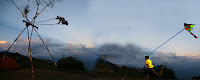
There is a tradition of getting new cloths and having big feast in this festival. Family gathering is the most loved part of this festival. Swings made up of bamboo and coconut rope is swinging all across the nation. There is a tradition to swing at least once in this festival. People say if you leave the ground swinging in Dashain,  the swing will take away ill feelings and replace it with new and rejuvenation inside oneself. Kit flying is another attraction for youth.


People all across the country worship Durga Bhawani and visit temples. It is called Nauratha visits. People wake up early in the morning and go to temples of Devi Durga. People perform musical programs and Ramlila in Madhesh and Terai region of Nepal. Nepal has its own music which symbolizes Dashain. The music is called Mal Shree Dhun. 


On the tenth day, people put Prasad of victory. In hilly reasons people put tika from the hands of elders on their foreheads. In some places people make a dummy of Raman and burn it in tenth day with performance of Ram Lila. Celebration differs according to geographic structure but all celebrate the same festival with same zeal and enthusiasm.

Dashain is the longest holiday in Nepal. Nepal Government closes about 7 days during this festival.

This festival is known for emphasis on family gatherings, as well as on a renewal of community ties. People return from all parts of the world, as well as different parts of the country, to celebrate this festival together.

What are the days in Dashain called


Dashain ko Tika
Dashain has 15 days celebration, however, following days are regarded as main days amogst them,


1st day Ghatasthapana  (Pratipada)
7th day Fulpati (Saptami)
8th day Asthami
9th day Navami
10th Vijaya Dashami (main Dashain Day) - Dashain ko Tika
11th Akadasi
15th Kojagrat Purnima


The first day of this festival starts from Ghatasthapana. The "Dashain Ghar", or special worship room, is set up, to start pooja of Durga Bhawani. This room is used to plant barley called Jamara in Nepali and to worship the Astha-Matrikas (the 8 tantrik Goddesses) as well as the Nava Durgas (the 9 Goddess Durga) for remaining 9 days.  (All these 9 days have their own importance in Dashain celebration). Barley is sowed in sand brought from river, and the barley is called Jamara when it is grown.  These seeds will sprout in ten days. The sprouts, which symbolize a good harvest, will be decoratively placed on the heads of family members later on in the festival as a blessing.


What are the stories behind Dashain celebration


There are so many stories behind Dashain celebration. Whatever the stories are, Dashain is celebrated as the victory of Good over evil.

Victory of Ram Chandra over Ravan (Rawana)


King Ram Chandra, whose wife Sita was kidnapped by King Rawan, with the help of hanuman and its military,


 conquered Rawan on the tenth day, after regular worship of Durga Bhawani for 9 days. The 10th day is the victory day. Therefore, we worship Durga Bhawani for 9 days and 10th day, make dummy of Ramwan and burn it symbolizing the end of evil. We put tika on our forehead as prasad of victory.

Victory of Durga Mata over Mahishasur


Demons, or Asuras, became very powerful and ambitious and continually tried to defeat the Devas, or Gods, and capture Heaven. One Asura, Mahishasur, in the form of a bull, grew very powerful and created havoc on the earth. Asuras started defeating the Devas and chasing them away from the havean. The world was crushed under Mahishasura's cruelty; the Devas put their energy together and form a Shakti, a single mass of incandescent energy, to kill Mahishasur.

A very powerful band of lightning emerged from the mouths of Brahma, Vishnu and Shiva and a young, beautiful female virgin with ten hands appeared. All the Gods gave their powers and special weapons to her. This Shakti blended to form the goddess Durga. With her vehicle riding on a lion, Durga Bhawanu, fought Mahishasur. The battle raged for nine days and nights. Finally on the tenth day of Ashvin shukla paksha, Mahishasur was defeated and killed by Durga. This is the day of celebration.

Diwali


What is Diwali? 

Diwali, or Deepavali, is one of the biggest Indian festivels and also a major occassion in Nepal. The festival has great religious significance for Hindus, Sikhs, Jains and the Nepalese. In India, Diwali is now considered to be more of a national festival, and is enjoyed by most Indians regardless of faith. It is commonly celebrated by decorating homes with lamps and candles, bursting of firecrackers and sparklers, eating sweets and other mouthwatering dishes, praying to Gods and Goddesses, observing religious rituals, wearing new dresses and sending wishes and gifts to one another. 

When is Diwali? 

Though the number of days of the celebration of the festival differ with different communities, the actual days of observance of Diwali are common and fall on exactly the same set of days across Nepal and India. Going by the Gregorian calendar, Diwali in India is observed generally in the months of October or November. The festival comes exactly twenty days after Dussehra, another sacred Hindu occassion, and is celebrated for five consecutive days at the end of Hindu month of Ashvin. Diwali is on 5th November, 2010 and 26th October, 2011.

What does Diwali mean?

DiyaThe word "Divali/Diwali" is a variation of the Sanskrit word "Deepavali" which means "a continuous line of lamps" (The word 'Deep' means "light", and 'avali' means "a continuous line"). Thus, Diwali is the time to celebrate with lights.

Hindus and Sikhs alike regard it as a celebration of life and use the occasion to strengthen family and social relationships. One of the most important Hindu festivals, Diwali marks the beginning of a new year in some Hindu calendars. For Hindus, the festival is not only the time to make merry but also the time to worship divine beings considered sacred in Hinduism like Lord Ganesha, Goddess Lakshmi and Lord Mahabali. It is also a significant festival for the Sikh faith. For Jains, it is an occasion to remember Lord Mahavira. In Nepal, Diwali is celebrated by many Buddhists as Tihar or Swanti.

Why is Diwali called the "Festival of Lights"?

Diwali is known as the "Festival of Lights". This is probably because of the manner in which it is observed. The festival is traditionally celebrated with activities like bursting crackers, lighting rows of candles and diyas (earthen lamps) around individual homes, holding dazzling fireworks display and igniting colourful sparklers. 

What happened during Diwali?
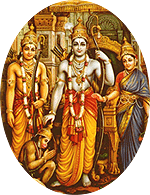
Rama, Laxman, Sita and HanumanKnown as the "Festival of Lights," Diwali commemorates the time when the Lord Rama returned to his hometown Ayodhya after defeating the evil demon king of Lanka, Ravana. Lord Rama was the king of Ayodhya who had, by his father's orders, went away from his country to live in the forest for fourteen years. But the people of Ayodhya loved their king very much and waited for years to meet with him again. And so, when news of Lord Rama's return came to them again, the people of Ayodhya, in the honour of their king and to celebrate his victory, burst crackers, lit up their houses with earthen lamps (diyas), and decorated the entire city in the grandest manner. Year after year this homecoming of Lord Rama is commemorated on Diwali with lights, fireworks, bursting of crackers and merriment. The festival gets its name Deepawali, or Diwali, from the rows (avali) of lamps (deepa) that the people of Ayodhya lit to welcome their King. 

Today Diwali is celebrated across the world as the "Festival of Light," where the lights or lamps signify victory of good over the evil within every human being .